Single Source

- One pre-installed Rb or Cs source
- Non-evaporable getter (NEG) optional

Typical flux
1 × 10^9/s
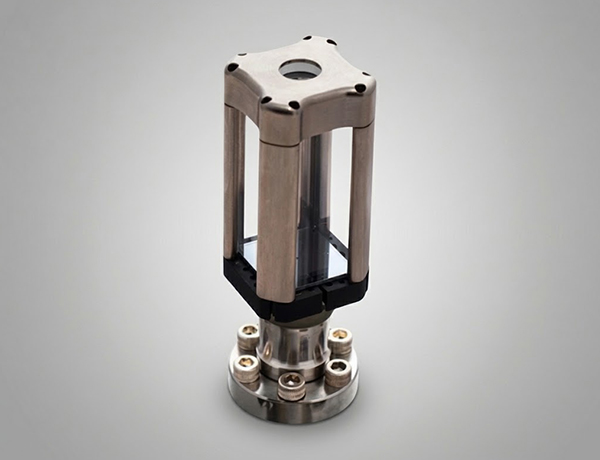
The Cold Atom Source Cell (CASC) combines an alkali vapor source, optical access, and a differential-pumping aperture in one compact component. With the right 2D MOT laser parameters, typical atom flux is 1 × 10^9 atoms per second.
Typical atom flux: 1 × 10^9 atoms per second. Output depends on 2D MOT laser parameters.
DN16 (1.33-inch) CF vacuum connection
2.75-inch adapter plate available
Up to two pre-installed Rb or Cs sources
Maximum bakeout temperature: 225 °C
Compact 30 × 30 × 94.6 mm footprint
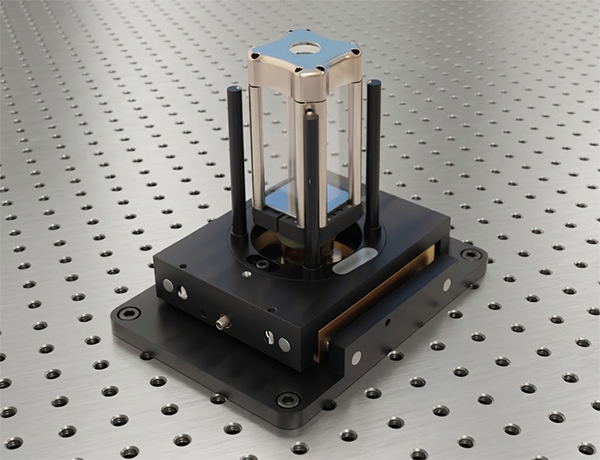
Product Options
Choose one or two pre-installed alkali sources to match your experiment. Configurations support rubidium, cesium, or both, with a common cell geometry and standard vacuum interface.
Typical flux
1 × 10^9/s

Two pre-installed sources

Two-species flexibility, custom offerings available
How It Works
External lasers and a magnetic field gradient capture atoms from alkali vapor in a 2D MOT. A push beam directs the cold atomic beam through the differential-pumping aperture.
Explore the User ManualDrive a pre-installed dispenser with constant current to generate rubidium or cesium vapor inside the cell.
External cooling and repump beams, paired with a magnetic field gradient, capture and cool atoms in two dimensions.
Direct a push beam along the cell axis to create a 2D+ MOT and move laser-cooled atoms toward the exit aperture.
The 0.75 mm aperture directs atoms into the connected vacuum system while supporting differential pumping.
Specifications
Key dimensions, interfaces, and performance values.
| Specification | Value |
|---|---|
| Overall size | 30 × 30 × 94.6 mm |
| Atom sources | Rb, Cs, or both |
| Vacuum interface | DN16 (1.33 in.) CF |
| Clear aperture | 40 × 16 mm sides; Ø10 mm end |
| Glass thickness | 1.5 mm |
| Vacuum aperture (pinhole) | Ø0.75 mm |
| Max. bakeout | 225 °C |
| Ramp rate | 1 °C/min |
| Typical atom flux | 1 × 10^9 atoms/s* |
| Exit velocity | 10–20 m/s axial; <1 m/s transverse* |
| Beam divergence | 4° full angle |
Related Products
Extend your setup with UHV glass cells and ready-to-use MOT systems from Infleqtion.
Find a distributor or request a quote to get started.