Superstaq

- Physics-aware compilation
- Cross-layer optimization
- Multi-backend execution
- QCVV and benchmarking
- 10x+ Benchmark gains

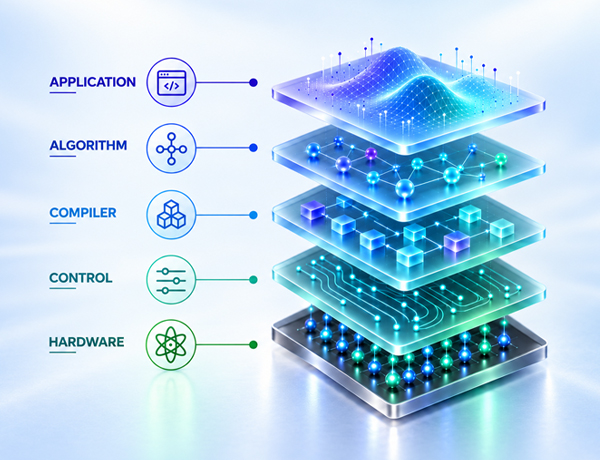
Quantum computers are specialized, resource-constrained, and sensitive to noise. Superstaq translates high-level algorithms into hardware-aware instructions and applies cross-layer optimization to help teams get more from each machine. By reducing the hardware resources some applications require, Superstaq can deliver the effect of hardware progress through software while helping teams determine whether results are meaningful, repeatable, and ready to scale.
Superstaq is the translation and optimization layer between user intent and improved performance on quantum hardware.
Cross-layer optimization down to device-native operations
10x or greater gains demonstrated on standard benchmarks
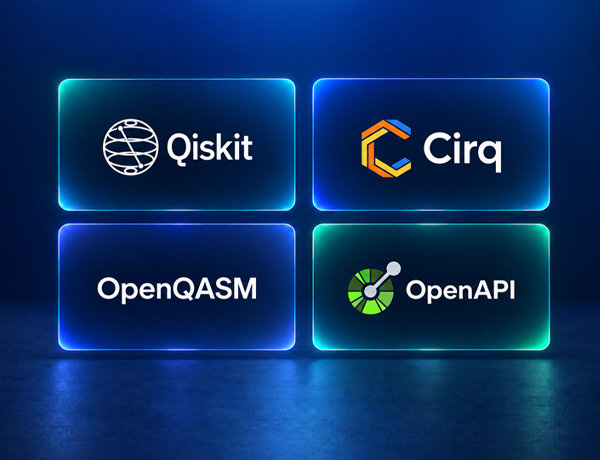
Qiskit, Cirq, OpenQASM, and OpenAPI support
One interface for multiple quantum backends
SOLUTIONS
Infleqtion brings compilation, application development, and quantum-inspired machine learning together to improve today's workflows and build toward fault-tolerant quantum computing.
Get Started

How We Engage
Infleqtion combines domain discovery, algorithm design, measurable prototyping, and resource planning to help teams decide where quantum belongs and what it will take to scale.
Discuss Your Use CaseDefine the business, scientific, or mission objective, the available data, and the performance threshold that would justify adoption.

Compare classical, quantum, hybrid, and quantum-inspired methods, then select an approach suited to the problem and available systems.

Implement a prototype and evaluate it with measurable benchmarks on simulators or real hardware, including Supermarq and QCVV where relevant.

Estimate resources, identify hardware requirements, and refine the application for today's systems and future fault-tolerant machines.

Superstaq Features
Get more from each circuit and each quantum system.
Exploit native operations with compilation informed by device architecture, connectivity, and noise.
Build with Qiskit, Cirq, or OpenQASM, or connect through OpenAPI to fit existing developer workflows.
Use one interface to target Infleqtion Sqale and other supported quantum backends as needs and hardware evolve.
Benchmark systems and characterize devices with Supermarq and QCVV experiments on simulators or live hardware.
Tools
Compile and benchmark now, then estimate resources and analyze codes for fault-tolerant systems.

Compile, optimize, execute, and benchmark quantum programs across multiple supported backends through Infleqtion's commercial software platform.
Estimate qubit counts, circuit runtimes, and sensitivity to compilation and error-correction assumptions for fault-tolerant neutral atom applications.

Construct and analyze quantum low-density parity-check codes, along with broader stabilizer and subsystem codes, using an open-source Python package.
Results
Superstaq is delivering results on quantum hardware across research and industry.







Superstaq's low-level quantum programming primitives unlock significant advances in performance for applications such as Toffoli gates and Hamiltonian simulation algorithms. The access to native gates and pulse-level controls is important for optimizing execution on quantum hardware.”
Applications
Explore quantum software use cases with measurable paths to value.
Model and optimize complex energy systems, including grid planning and contingency analysis, with quantum and hybrid approaches.
Develop quantum and quantum-inspired methods for trusted signals, RF awareness, navigation resilience, and advanced compute.
Explore optimization and simulation methods for portfolio construction, risk analysis, and other constrained financial problems.
Investigate biomarker discovery, precision oncology, genomics, and other data-scarce problems with complex correlations.
Design and test algorithms for molecular and materials modeling, including applications that use logical qubits.
Apply quantum-inspired machine learning to long-range correlations, wider context, and real-time multi-sensor intelligence.
Related Products
Connect software to Infleqtion's neutral atom quantum computing and quantum-inspired AI capabilities.

Run algorithms on Infleqtion's full-stack neutral atom quantum computing platform, built for logical qubits and fault-tolerant scale.

Use quantum-inspired machine learning to process long sequential data with wider context on today's classical GPUs.
Superstaq is Infleqtion’s quantum software platform for compiling, optimizing, and running quantum programs. It translates a user’s circuit into operations tailored to the selected device, including low-level, physics-aware optimizations. The goal is to improve effective hardware performance and make different quantum systems easier to access through a consistent workflow.
Quantum compilation converts an algorithm or circuit into the native instructions a specific quantum processor can execute. A strong compiler accounts for the device’s qubits, connectivity, gates, controls, noise, and timing constraints. Superstaq optimizes across these layers so a workload can use the underlying hardware more effectively.
Superstaq supports common quantum development formats and frameworks, including Qiskit, Cirq, and OpenQASM, plus custom integrations through OpenAPI. It can target Infleqtion’s Sqale systems and supported third-party backends through one interface. Specific backends and access conditions may change, so developers should consult the current Superstaq documentation for the latest compatibility list.
Superstaq applies device-aware circuit, gate, and pulse-level optimization, along with tools for noise suppression and error management. Infleqtion reports performance improvements of at least 10 times on selected standard benchmarks, but gains vary by circuit, hardware, and comparison method. The relevant measure is whether optimization improves fidelity, depth, runtime, or resource use for the user’s actual workload.
Yes. Infleqtion’s applications team works with organizations to identify suitable problems, estimate quantum resources, design hybrid quantum-classical algorithms, and build credible prototypes. Current research areas include energy, finance, materials, life sciences, AI, and national security. This work helps teams test value and prepare workflows while quantum hardware continues to advance. Contact us to discuss your quantum application project.
Move from problem framing to a tested prototype.