Quantum Spectrum
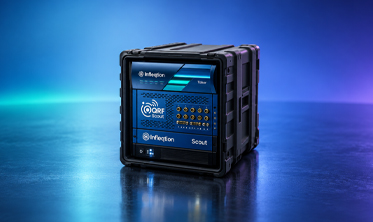
- 3 MHz-6 GHz coverage
- Small-aperture atomic receiver
- Rugged, modular architecture
- Ground and air applications

Availability
Available Now

A room-temperature vapor cell responds directly to RF electric fields. Optical readout converts that interaction into usable signal information without a conventional antenna and analog receiver chain.
Ultra-broadband sensing from a small aperture.
Robust operation in congested RF environments.
Multi-channel architectures for simultaneous sensing.
A modular path to mobile and embedded deployment.

Roadmap Highlights
Each generation of Quantum Spectrum expands frequency coverage and deployability. Roadmap specifications are targets and subject to change.
Get a Demo
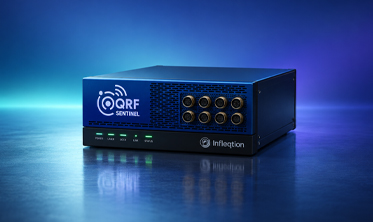
Availability
Available Now
Availability
Inquire
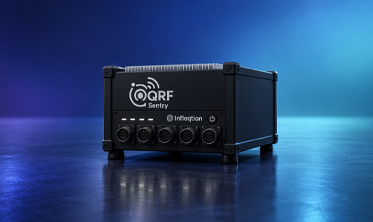
Availability
Planned
Collaborations
Government-backed development and field evaluation.





Applications
Detect, understand, and act in complex RF environments.
Detect and monitor RF activity in contested, jammed, spoofed, or GPS-denied environments.
Identify interference, locate emitters, classify signals, and manage scarce spectrum resources.
Develop broadband, multichannel, and converged sensing-and-communications architectures.
More Solutions
Pair RF awareness with resilient time and signal understanding.

Add stable local timing for coherent sensing, synchronization, and GPS-denied operation.

Advance resilient navigation and gravity sensing with neutral atom systems designed to measure motion precisely without relying on GPS.

Interpret long RF sequences and extract context from complex signal environments
Infleqtion Quantum Spectrum is an RF sensing architecture that uses highly excited Rydberg atoms as the sensing element. It is designed to detect, assess, locate, and classify RF signals across a broad frequency range. By moving RF detection into the atomic and optical domains, the architecture can reduce dependence on conventional antennas and analog receiver chains.
Lasers prepare atoms in sensitive Rydberg states, where an incoming RF field changes the atoms’ energy levels. A probe laser reads those changes, converting information about the RF signal into an optical measurement. Because atomic transitions are precisely defined and broadly tunable, one receiver architecture can address frequencies that normally require multiple conventional front ends.
The architecture is designed to replace key antenna and analog receiver functions by sensing RF fields directly with atoms. That can enable broad tunability from a small aperture, particularly at frequencies where conventional antennas become large. A fielded system still needs optical hardware, electronics, signal processing, packaging, and integration with the user’s wider RF system.
Potential advantages include ultra-broadband tuning, compact aperture, low power, covert or electromagnetically quiet reception, and resilience in congested or contested spectrum.
Applications include spectrum monitoring, interference detection, electronic support, signal geolocation, communications, drone and threat detection, and RF awareness in GPS-denied or contested environments. Infleqtion is developing the technology for national security and commercial needs where wide frequency coverage and compact deployment matter.
Discuss your use case with our team.