Encode More Context
Represent relationships across extended sequences using a compact quantum-inspired model.
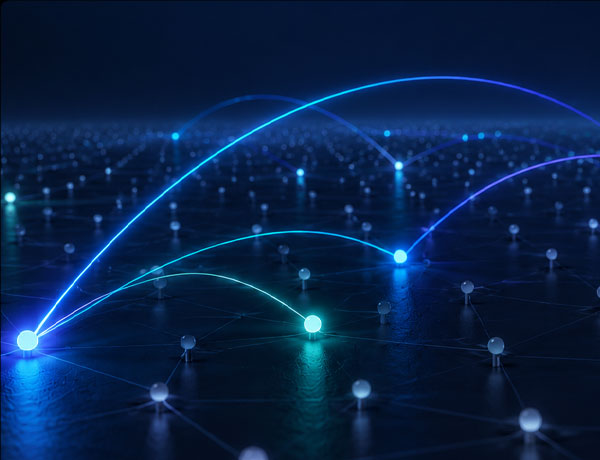
Transformers and other sequence models can become increasingly expensive as their context grows. CML uses a quantum-inspired architecture to capture long-range correlations with fewer parameters and more efficient runtime scaling.
CML is inspired by quantum contextuality: the way a quantum system's response depends on the surrounding measurement context.
Runs on commercial NVIDIA GPUs using CUDA-Q.
Supports smaller models for compact edge platforms.
Processes long, sequential, and multisource data.
Creates a path to native QPU acceleration.
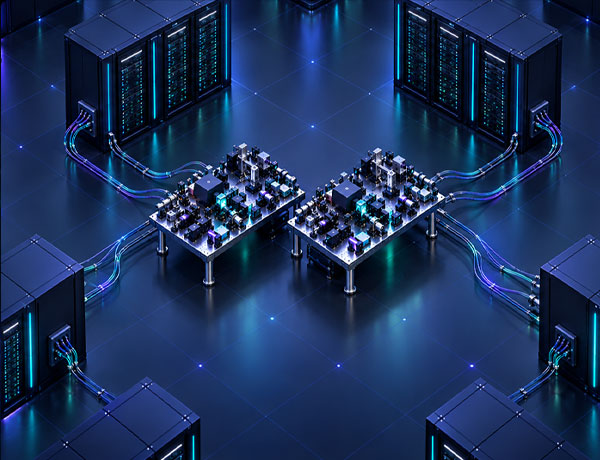
How CML Works
CML applies ideas from quantum contextuality to model long-range relationships efficiently. It runs through GPU simulation today and is designed for native execution on future QPUs.
Read the ResearchRepresent relationships across extended sequences using a compact quantum-inspired model.
Use accelerated computing and CUDA-Q to apply CML to real workloads on commercial hardware.
Carry the architecture to quantum hardware as useful QPU capability becomes available.
Capabilities
Efficient learning for long, multisource data streams.
Learn from longer histories to improve prediction and pattern recognition across sequential data.
Reach strong task performance with smaller models and lower memory requirements.
Run compact CML models on NVIDIA Jetson platforms where bandwidth, power, and connectivity are constrained.
Deploy quantum-inspired algorithms now while building toward native quantum acceleration.
CML at Work
CML is already driving results in language, genomics, PNT, and RF.



There is a symbiotic relationship between AI supercomputing and quantum computing. Infleqtion's work demonstrates how NVIDIA's CUDA-Q platform is bringing accelerated computing to quantum workflows, and how these workflows are finding application reaching beyond quantum computing.”
More Solutions
More quantum solutions powered by neutral atoms.
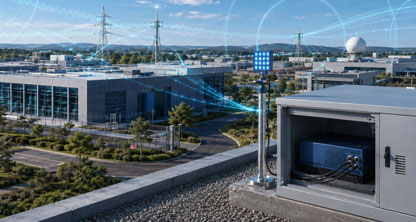
Pair CML with quantum RF sensing to compress, classify, and prioritize signals in real time.
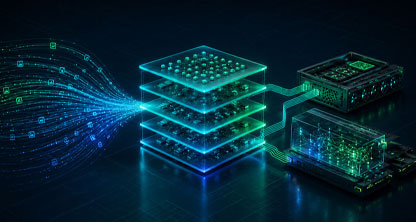
Move from application requirements to optimized quantum and hybrid workflows with Infleqtion software expertise.
Our neutral atom, fault-tolerant quantum computer delivers scalability, speed, and fidelity to unlock the classically impossible.
Contextual Machine Learning, or CML, is Infleqtion’s quantum-inspired approach to learning from long sequences and multiple data sources. It is designed to preserve more relevant context without the steep memory and compute growth that can limit conventional sequence models. That can improve pattern recognition, forecasting, anomaly detection, and real-time decisions in data-rich applications.
No. Infleqtion designed CML for quantum processors, then adapted it to run on commercially available GPUs, including edge platforms. Organizations can evaluate CML in current AI workflows without waiting for fault-tolerant quantum hardware. The architecture also provides a path to future hybrid GPU-QPU execution as quantum processors mature.
Transformers can become increasingly expensive as their context windows grow because they must model relationships across long sequences. CML uses an architecture inspired by quantum contextuality to capture long-range correlations with smaller models and more favorable scaling for certain tasks. Performance depends on the dataset and use case, so CML should be evaluated against relevant baselines rather than treated as a universal replacement for transformers.
CML is designed for problems where useful information is distributed across long timeframes, large sequences, or multiple sensor streams. Examples include RF signal processing, assured navigation, autonomous-system data, energy-demand forecasting, genomic analysis, and other long-context scientific or operational workloads. It is especially relevant when inference must run with limited memory or compute at the edge.
Infleqtion has reported results in sequence translation, genomics, and RF processing, including matching transformer performance on a Spanish-to-English task with 10 times less memory and strong internal results on mouse enhancer classification. CML also supports U.S. Navy and U.S. Army programs for RF analysis and resilient positioning, navigation, and timing. Results are workload-specific, and some published website figures are identified as internal data.
Explored quantum-inspired AI with our experts.