Start With Atoms
Identical neutral atoms provide a reconfigurable foundation for quantum computing, sensing, and timing.
Turning complex optical systems into compact, scalable quantum technology.
At Infleqtion, integrated photonics is the bridge between the performance of neutral atoms and the scale of manufactured technology. Photonic integrated circuits can consolidate lasers, frequency control, beam steering, and other optical functions onto compact chips. Paired with our quantum cores, control systems, and software, they can replace optical-table complexity with smaller, more rugged architectures. Because the same atom-and-light foundation spans our computing, timing, RF sensing, and inertial sensing portfolio, advances in photonics can strengthen multiple products and create a more repeatable path from the lab to deployment.
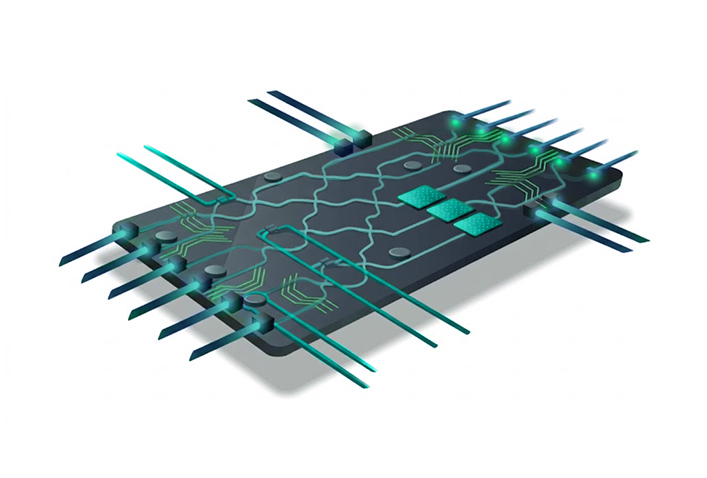
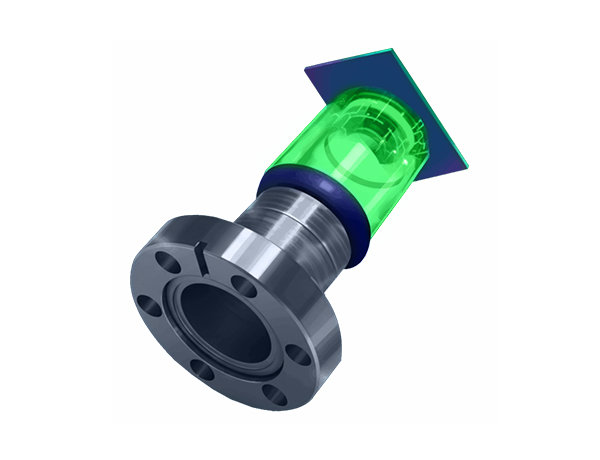
Neutral atoms are uniform by nature, but unlocking their value takes precise optical control. Lasers and related optics drive much of a quantum system’s size, weight, power, and cost. PICs bring that control onto chips designed for stability, repeatability, and scale.
Infleqtion’s approach joins quantum cores, neutral atoms, integrated photonics, control electronics, and software in one vertically integrated platform.
Computing: Fast, chip-scale control can address neutral atoms and support more compact, scalable quantum computers.
Timing: PIC-based lasers and frequency combs can miniaturize precision clocks and frequency control.
RF sensing: Integrated optics can help bring ultra-broadband quantum receivers onto mobile and fielded platforms.
Inertial sensing: Compact optical control can help ruggedize precision navigation for GPS-denied environments.
How It Works
Infleqtion combines a proven neutral atom platform with photonic integration built for scale.
Identical neutral atoms provide a reconfigurable foundation for quantum computing, sensing, and timing.
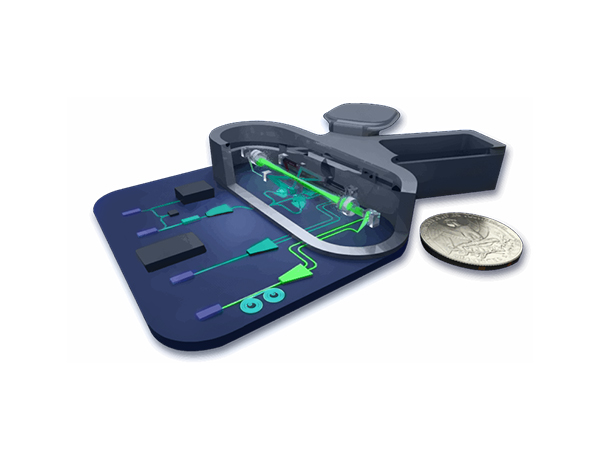
Precision lasers cool, trap, manipulate, and measure atoms to execute precise quantum operations.
PICs bring complex laser, frequency-control, and atom-addressing functions onto compact chips.
Foundry-compatible processes can reduce size, weight, power, and cost while improving manufacturability.
Differentiators
Core, atoms, and light work together to turn quantum physics into complete systems.
A sealed glass cell creates the controlled vacuum where atoms are cooled, trapped, manipulated, and measured with light.
Uniform by nature and controlled optically, neutral atoms support flexible arrays for quantum computing and precision sensing.
Integrated photonics places optical functions on photonic integrated circuits, or PICs. Instead of relying only on separate lasers, lenses, modulators, and other components assembled across an optical table, a PIC can combine multiple light-based functions on a compact chip. For quantum systems, this approach can reduce size, weight, power needs, cost, and manufacturing complexity.
Integrated photonics can make quantum systems easier to manufacture, deploy, and maintain outside specialized laboratories. Quantum computers and sensors require precise generation, routing, modulation, and control of light. Moving more of those functions onto chips creates a path toward smaller, more rugged systems with repeatable performance and a supply chain that can support broader commercial production.
Infleqtion uses light to cool, trap, control, and measure neutral atoms. Integrated photonics can consolidate parts of that optical control system, including precision lasers, frequency control, beam delivery, and atom addressing. This makes photonics a key engineering layer between Infleqtion’s neutral atom core and complete quantum systems for computing, timing, spectrum sensing, and inertial sensing.
No. Infleqtion’s quantum computers use neutral atoms as qubits. Integrated photonics provides the light-generation and control technologies used to operate those atoms. Infleqtion is developing photonic integration to improve the manufacturability and deployment profile of neutral atom systems, not to replace neutral atoms with photonic qubits.
Infleqtion is incorporating photonic integrated circuit elements and fiber-connected optical subsystems across its portfolio. The degree and timing of photonic integration vary by product and application.
Not yet. Fully PIC-based quantum systems, including workstation-scale quantum computers, remain a longer-term development direction whose timing depends on the application, engineering progress, and manufacturing infrastructure.
Build what comes next with Infleqtion.