Infleqtion’s Sqale quantum computer entangled 30 logical qubits using 80 physical qubits. Our next commitment is 100 logical qubits by 2028.
Neutral atoms were once a dark horse in quantum computing. I started my career working on trapped-ion machines, then built a software company whose customers worked across several approaches, including superconducting qubits. In 2021, our software team went all in on neutral atoms. This September, we announced that our Sqale quantum computer had entangled 30 logical qubits using 80 physical qubits. We hit our 2026 computing milestone ahead of schedule.
This spring, Google made a bet of its own. In April, it opened a neutral atom lab in Boulder led by Harmut Neven. As Cade Metz reported in The New York Times, what caught Neven’s attention was the progress other teams were making on error correction. Adam Bluestein’s piece in Fast Company puts Google’s move into context.
By the time Google opened its Colorado lab, we’d been building neutral atom technology in Boulder for nearly 20 years. We started as ColdQuanta in 2007. By 2020, we’d publicly previewed our neutral atom quantum computer. In 2024, we ran a materials-science calculation on two logical qubits on Sqale. A year later, we ran a sequence of gates across 12 logical qubits on that same machine.
Nicholas Thompson, CEO of The Atlantic, asked in The Most Interesting Thing in Tech whether a breakthrough with neutral atoms could “speed up progress in quantum computing.” He also pointed to a practical advantage: the lower cost requirements posed by neutral atom could put these machines within reach of more research labs. In December 2025, we delivered the U.K.’s first operational 100-physical-qubit quantum computer to the National Quantum Computing Centre at Harwell. In Japan, our processor powers Shunkai, the country’s first operational full-stack neutral atom quantum computer.
How Sqale entangled 30 logical qubits using 80 atoms
A logical qubit encodes quantum information across several physical qubits so we can check for errors. On Sqale, we arranged 80 atoms in ten blocks of eight. Each block encoded three logical qubits. That gave us 30. The next step was to entangle all 30 in a single quantum state.
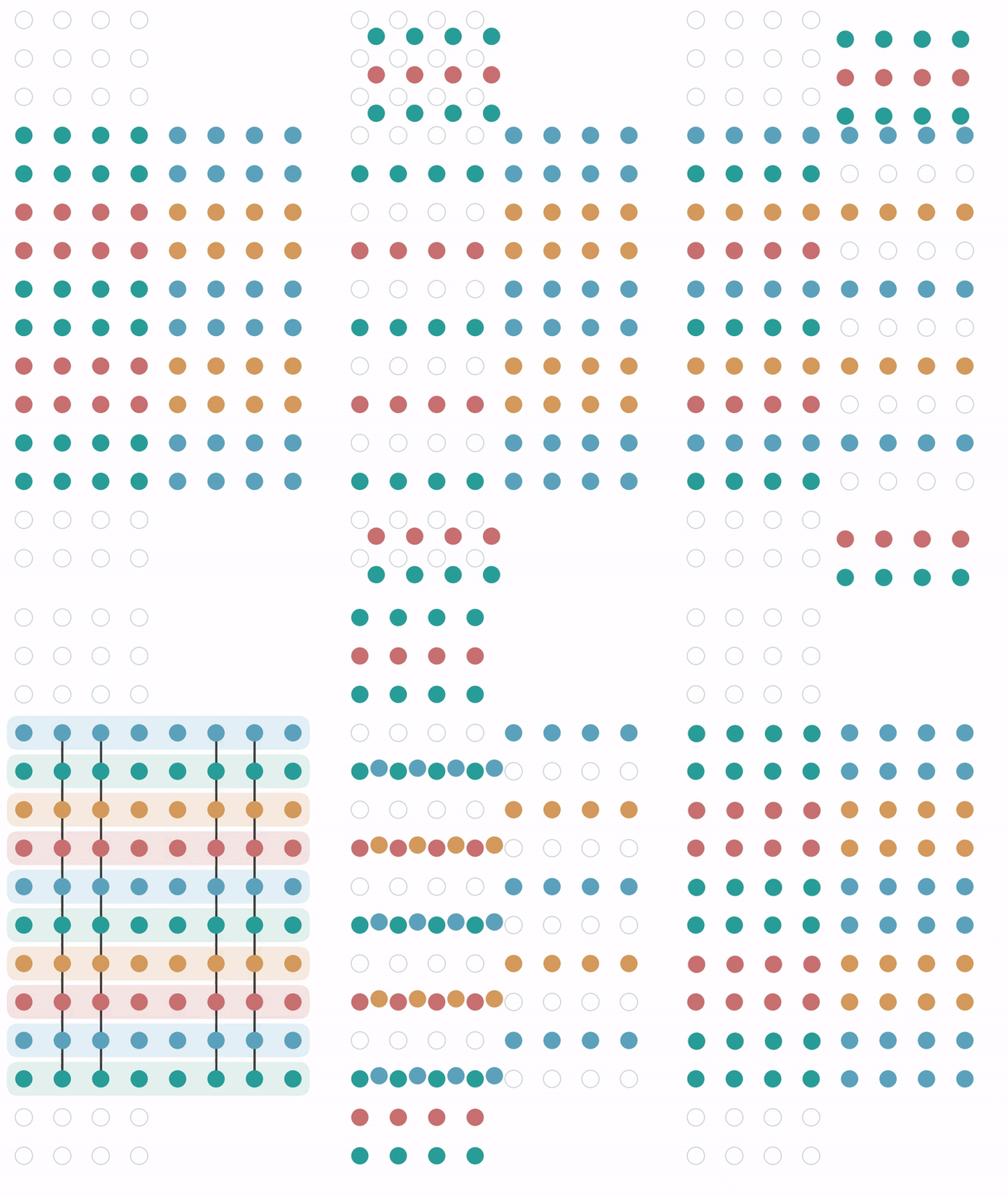
We used Superstaq, our quantum software platform, to compile the circuit for Sqale. In the sequence we ran on our actual machine, you can see where we brought atoms together to connect the blocks and where we ran gates on atoms already in place.
One operation in that circuit shows why the software matters. The way we knew to entangle qubits across blocks took eight physical two-qubit gates. An AI-assisted search helped us find a way to do it in four. We used that operation in the 30-logical-qubit experiment. Each time it came up, Sqale had four fewer gates to run.
Infleqtion’s head start
We use the same core technology across quantum computing and sensing. Take an atomic clock. We tune a laser to a frequency the atoms respond to and use that response to keep time. On Sqale, our neutral atom quantum computer, we use laser light to control individual atoms as qubits. Both jobs require us to hold atoms where we want them and control the light that reaches them. By the time we previewed the computer, the team had spent more than a decade building equipment to do just that.
Why neutral atoms scale
On a superconducting chip, each qubit is a circuit you have to fabricate. On Sqale, each physical qubit is an individual atom. Nature makes the qubits for us. Atoms of the same isotope are identical, so what we learn about controlling one carries over to the next. To grow the array, we trap more atoms with tightly focused laser beams called optical tweezers.
Coming from a dual background in physics and software, I care just as much about which qubits can interact. Suppose a calculation calls for a gate between two qubits on opposite sides of a processor. On a chip where qubits connect directly to their neighbors, reaching across the chip takes extra operations. On Sqale, we can move the two atoms next to each other. If they’re already in position, we can address that pair and run the gate right there. As we add atoms, we keep that freedom to choose which pairs interact.
We delivered 30 entangled logical qubits ahead of schedule. Our next commitment is 100 logical qubits by 2028.
We made our bet, and we’ve never been more confident that the path to quantum utility will run through neutral atoms.