A quantum optical atomic clock keeps time by counting an atomic transition in the optical range, giving it substantially greater stability than compact chip-scale atomic clocks (CSACs) and cesium-beam references. For position, navigation, and timing (PNT) in GPS-denied environments, that stability is the difference between holding position for minutes and holding it for days.
Tiqker is the Timing Layer of PNT
Tiqker delivers the precise, resilient time reference that positioning, navigation, and communications systems depend on. Making that timing usable across a real deployment also means synchronizing and distributing it to every system that relies on it, which is where our partnership with Safran Electronics & Defense comes in. Since April 2026, we’ve offered a commercially available bundle combining Tiqker with Safran’s White Rabbit and SecureSync synchronization and distribution systems, validated in a live demonstration with Quantum Corridor at picosecond-level accuracy, compared to the nanosecond-level accuracy typical of GPS, and available through Safran’s existing global distribution and support network.
Where Tiqker Sits Among Other Clocks
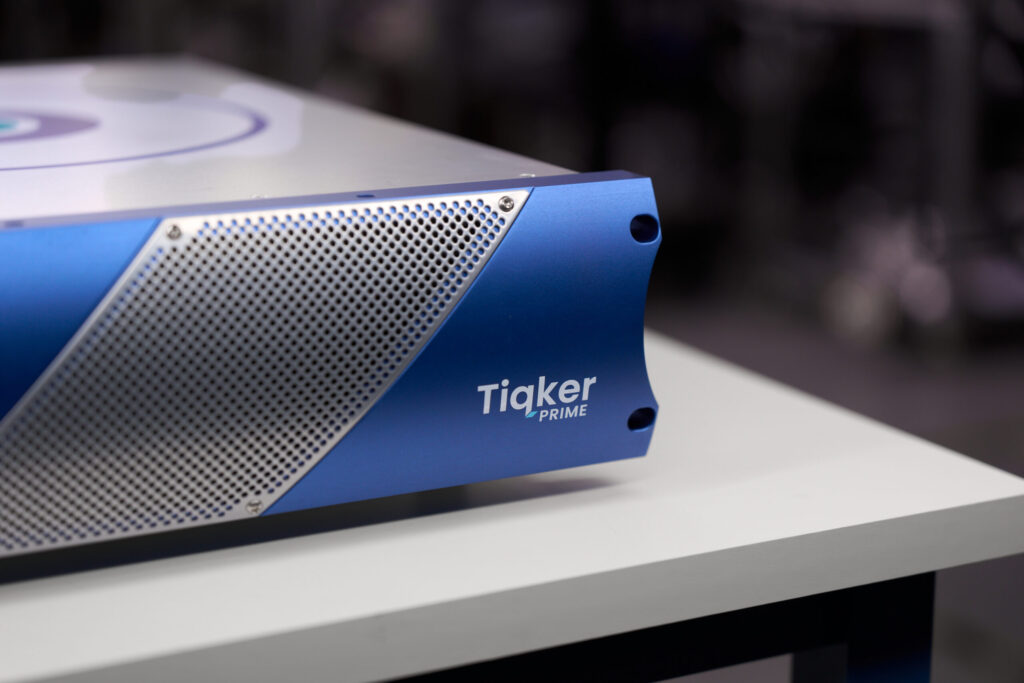
Tiqker occupies the same rack space as a cesium-beam frequency reference (roughly 30 liters, 30 kilograms, in a standard 3U rack mount) while delivering hydrogen-maser-like short-term stability at roughly a tenth of a maser’s size. On short-to-mid timescales, Infleqtion states Tiqker outperforms cesium-beam references, rubidium atomic frequency standards (RAFS), and CSACs directly.
What GPS Denial Actually Costs a Platform
A submarine, an aircraft in contested airspace, or a satellite that loses its GPS fix does not just lose a position fix. Its onboard systems begin drifting against each other, since navigation, secure communications, and sensor timestamping all depend on a shared, accurate clock. The longer a platform must operate without GPS, the more that drift compounds.
Why the Size and Cost Tradeoff is Changing
Hydrogen masers deliver strong short-term stability but at significant size and power cost. We build Tiqker’s lasers and frequency combs as photonic-integrated circuits (PICs), the same chip-scale manufacturing used for CPUs and GPUs, which gets us to roughly a tenth of a maser’s footprint today, with further miniaturization toward true chip-scale on our roadmap.
What This Looks Like in the Field
Tiqker was successfully trialed in October 2025 aboard the Royal Navy’s Excalibur (XCal), an uncrewed, autonomous underwater testbed vehicle. It has also shipped commercially, including the first sale and delivery of any optical atomic clock in the UK.
Where this Technology is Still Maturing
Today’s Tiqker is a genuine leap in size and power over a hydrogen maser, but it is still a rack-mounted instrument, not a chip-scale device. That remains a roadmap target, not a current capability.
FAQ
Synchronized, distributable timing solution: Tiqker as the precision time source, paired with Safran’s White Rabbit and SecureSync systems to distribute that timing across a network.
Not yet. Tiqker today is a rack-mounted instrument, about a tenth the size of a hydrogen maser, with chip-scale modules on the roadmap.
Not on its own. It provides a highly stable local time reference, letting a platform hold accurate timing and navigation longer when GPS is unavailable, as part of a fuller integrated system.