
Today at Quantum World Congress 2026, we are announcing a demonstration of 30 logical qubits on Infleqtion’s Sqale neutral atom QPU, fulfilling our roadmap commitment for this year. We completed these experiments in August, using 80 physical qubits and our Superstaq software platform to efficiently compile the circuits for execution on hardware.
Last week we described integrating NVIDIA CUDA-Q Logical with our qLDPC library. That work centered on overhead: how few physical qubits it takes to build one reliable logical qubit. Today’s results put the same question to hardware.
The centerpiece is an IQP circuit (diagonal gates sandwiched by Hadamard gates) with entangling gates connecting all 30 logical qubits, with approximately 1,000 physical quantum operations, i.e. 1 KiloQuOp. It brings together efficient encoding, non-Clifford gates and a new logical entangling operation discovered with AI. It also gives us an early look at how loss correction can increase the number of useful results our customers can obtain from execution on Sqale.
From Two Logical Qubits to Thirty
In 2024, we demonstrated two logical qubits on Sqale. Individual optical addressing let us entangle selected atoms in place, with a median two-qubit gate fidelity of 99.48% after post-selection for atom loss. Superstaq connected GPU-accelerated simulation to execution on our QPU, culminating in the first-ever prototype materials-science calculation with logical qubits as detailed in our publication with NVIDIA, UChicago, and UW-Madison.
At Quantum World Congress in 2025, we extended that work to CNOT ladders on 12 logical qubits, state preparation in a distance-4 many-hypercube code encoding four logical qubits, and the first logical-qubit realization of a pre-compiled version of Shor’s algorithm.
Two logical qubits in 2024, twelve in 2025, thirty today.
Thirty Logical Qubits in Eighty Atoms
For the new experiments, we group 80 atoms into ten blocks of eight. Each block is prepared into the |000> state for the distance-3 [[8,3,3]] error-correcting code to encode three logical qubits. That gives us 30 logical qubits at an 8:3 physical-to-logical ratio. Atom motion provides all-to-all connectivity, while individual addressing lets us entangle selected atoms in place. Together, these capabilities let us prepare the blocks and couple them efficiently.
In our downstream experiments, we operate the qubits in the [[8,3,2]] distance-2 encoding, which can detect any error or correct for a lost atom. Our experiments initialize these triplets of logical qubits to the |+++> state.
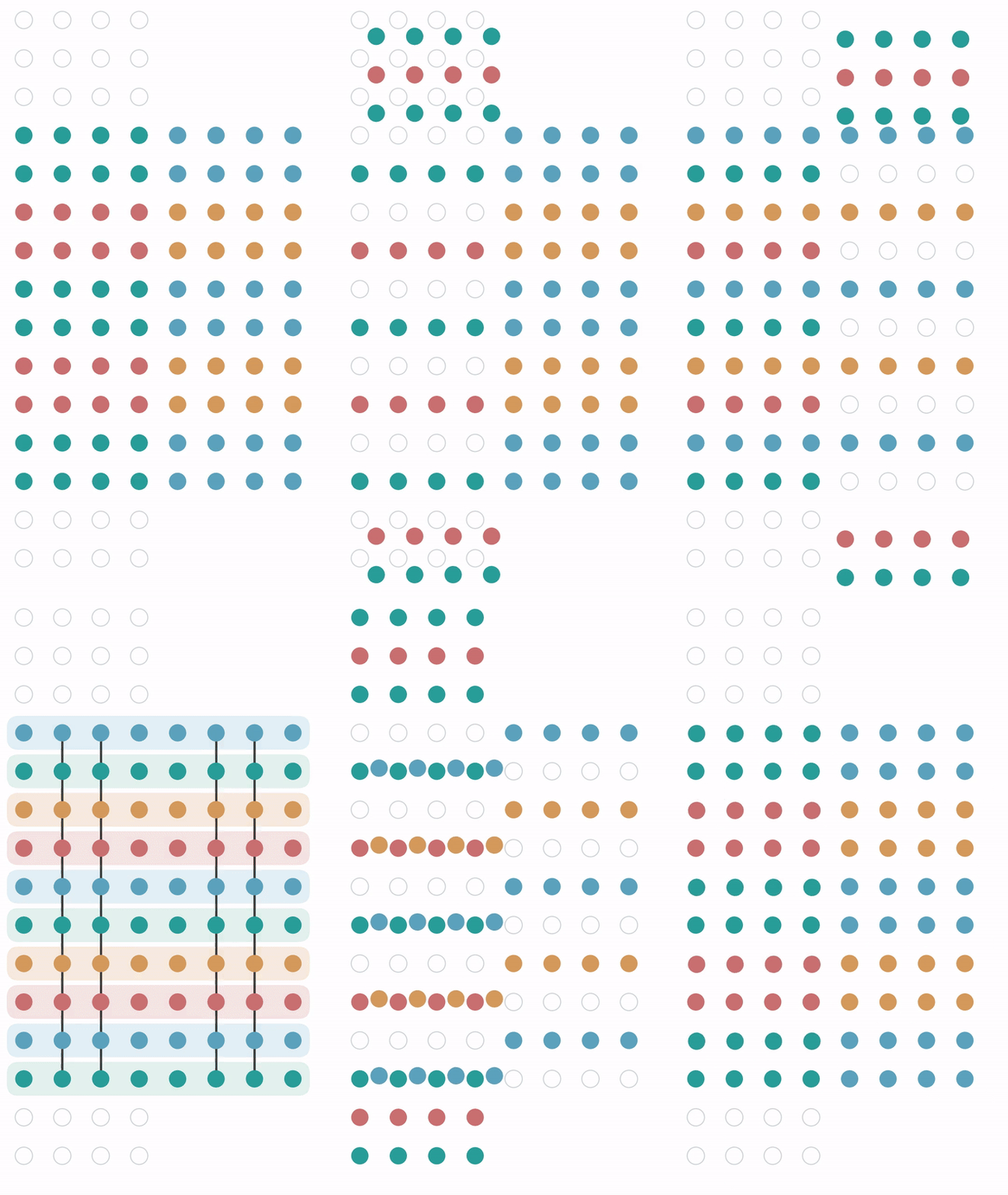
Finding a Needle in a Billion Possible Outcomes
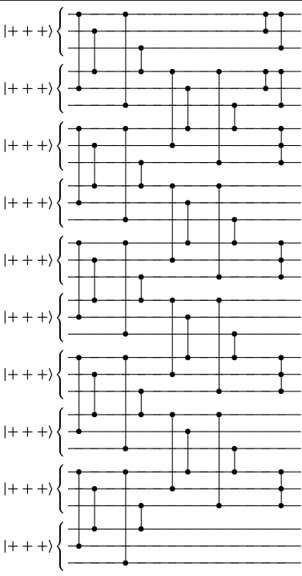
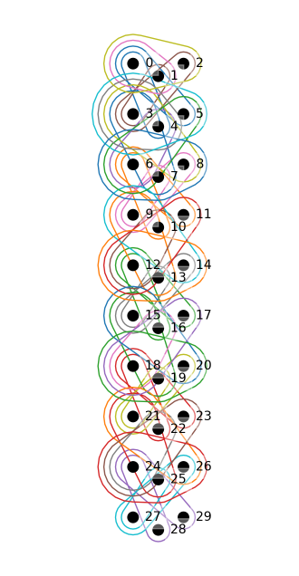
Preparing 30 logical qubits is the starting point. To evaluate the performance of our logical qubits, we execute an IQP circuit, short for Instantaneous Quantum Polynomial time. These circuits apply commuting phase gates to our logical qubits initialized to |+++> ⊗30, prior to measurement in the X basis. Our circuit includes interactions across all ten blocks, as shown in the logical circuit and corresponding hypergraph below.
There are more than a billion possible 30-bit measurement outcomes. The ideal circuit produces only 262,144 of them: about 0.024% of the possibilities. Think of that small set as the needle in the haystack. Uniformly random outputs would catch the needle only once every 4,096 samples on average.
In our experimental dataset, we observed hit fraction of approximately 25%, roughly 1,000 times the uniform-random baseline. This clear signal above the noise confirms the experimental realization of a 30 logical qubit state, performing a calculation that entangles across each of the 30 logical qubits and across each of the underlying 80 physical qubits.
Four Technical Details Behind the Result
1 An entangling gate discovered with AI
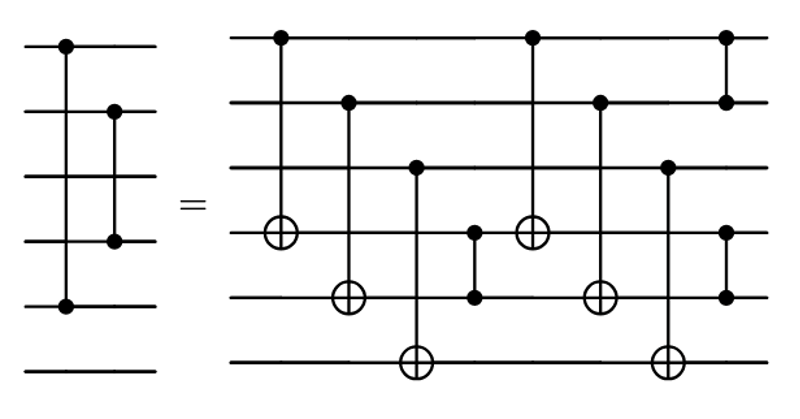
During our work, the GPT 5.6 Sol model helped us discover a novel way to entangle across triplets of logical qubits. To our knowledge, until this discovery the only known mechanism for this entanglement was the transversal CX, which required 8 physical 2Q gates per logical entanglement. Our AI-discovered logical gate, which we call a double-CZ, enabled us to halve this cost to 4 physical 2Q gates. This enabled us to achieve our entangled 30 logical qubit state with 136 physical 2Q gates, which boosted the yield and fidelity of our circuits. The identity below explains the double-CZ operation and why it works.
2 Efficient non-Clifford gates
Our circuit includes four logical CCZ gates, which are three-qubit gates that belong to the non-Clifford family of operations needed for universal quantum computing. As exemplified in previous work from Harvard, the [[8,3,2]] code gives us an efficient transversal implementation of the logical CCZ gate using eight physical qubit rotations.
As we scale up to bigger demonstrations, experimental demonstration of non-Clifford gates bolsters our confidence in the path to quantum computing that will escape classical simulability. On our neutral atom platform, we can achieve these non-Clifford gates with modest physical overhead.
3 More useful outputs through loss correction
When an atom is lost, we know which qubit is missing. That information can make the event recoverable. In these experiments, parity constraints let us reconstruct a missing X-basis measurement outcome in a block with one lost atom. This technique is known as loss correction and can be performed in post-processing with software.
Applying loss correction to our data enabled us to quadruple the number of good shots or “needle found in the haystack”. This technique does come at the cost of greater error rates, but importantly it gives our customers a fine-tunable knob for trading off between the throughput and accuracy of shots.
4 Training on GPUs and sampling on QPUs
IQP circuits also connect this hardware work to applications. For suitable training objectives, we can use classical computers to train a model, then use a quantum processor to sample from it. The division resembles the separate training and inference stages of a neural network: GPUs optimize the parameters, and the QPU generates candidates from the trained distribution.
We have already pursued this approach on logical qubits with our Wellcome Leap customer in our Q4Bio work on biomarker discovery. That workflow combines GPU-accelerated training and simulation with logical-qubit execution on Sqale. Scaling the number of logical qubits lets us test larger models and the higher-order correlations they encode.
Toward Longer Useful Computations
Having achieved our roadmap commitment to 30 logical qubits in 2026, our attention now turns to our target of 100 logical qubits in 2028. Our ambition over the next few years is to reach and surpass the MegaQuOp era, where machines can sustain roughly a million reliable logical operations in a computation. Reaching that scale will require much stronger error suppression, but the good news is that the cost of quantum error correction scales (poly)logarithmically in logical error rate—meaning that we’ll make exponential progress in climbing from KiloQuOp to MegaQuOp and beyond.
Our priorities to this end include real-time control and mid-circuit measurement to go beyond post-selection, tighter integration with HPC and GPUs, and continued software advances in efficient logical architectures.
We plan to release a full paper for our 30 logical qubit results in the coming weeks, with details on experimental methods, resource counts, and statistical analysis. We will be discussing these results in more detail at Quantum World Congress this week, and we invite attendees to stop by and speak with our team.
Thanks to the Sqale QPU hardware and Superstaq quantum software teams for the experimental and software work behind these exciting results! If you are excited about building the world’s first utility-scale quantum computers, check out our careers page.