
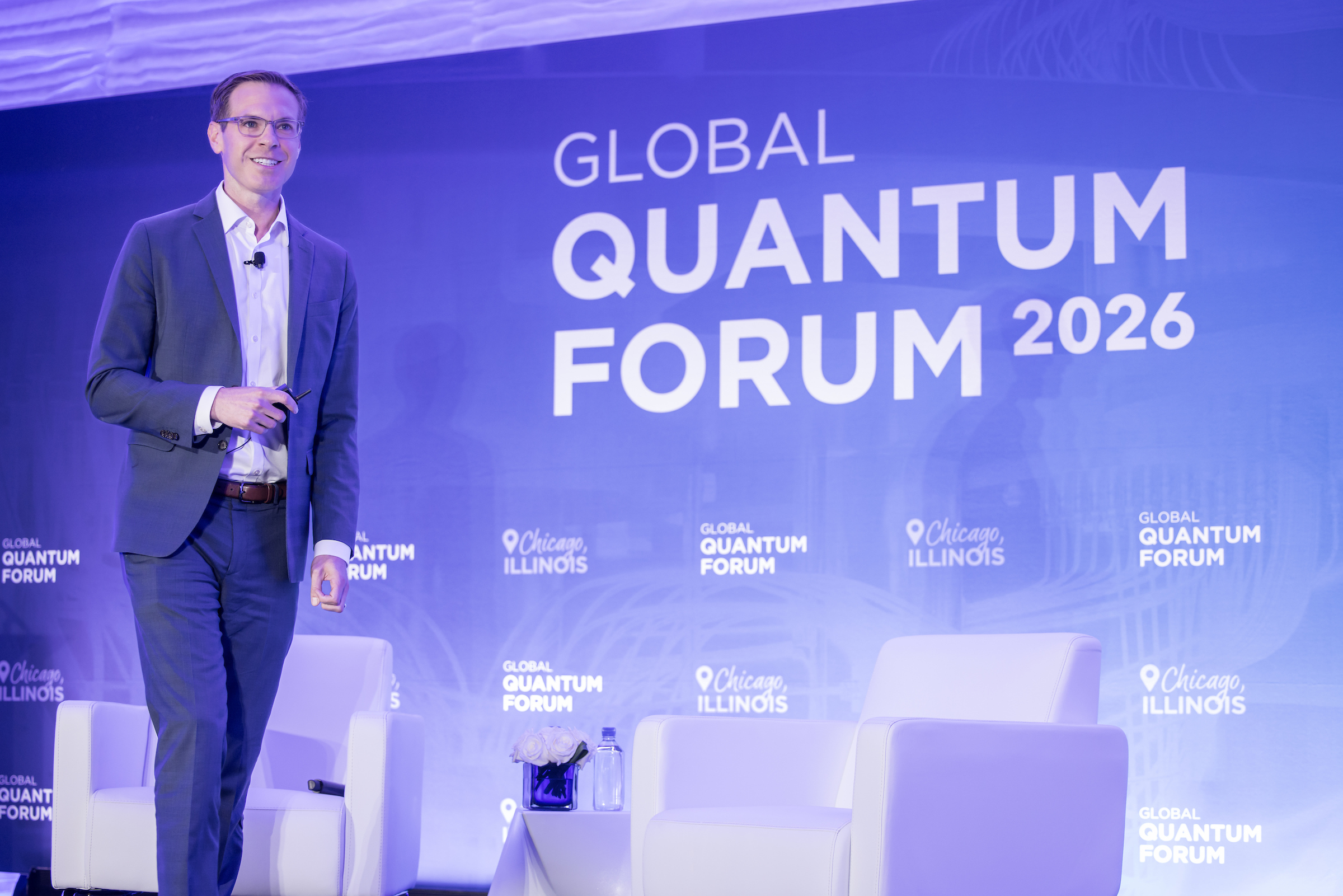
At this year’s Global Quantum Forum in Chicago, I had the opportunity to share why I believe quantum represents the next great technological revolution and why we’re entering what I call the Precision Era.
There was no better place to have that conversation than Chicago. Although I haven’t lived here in more than 20 years, it will always be my hometown. I still follow the Chicago sports team (Go Cubbies!) with the same optimism I had growing up, and every trip back reminds me how much the city has shaped me.
It’s also incredibly rewarding to return as CEO of Infleqtion. Chicago isn’t just where I grew up. It’s becoming one of the most important quantum ecosystems in the world. The combination of world-class universities, national laboratories, entrepreneurs, investors and public leadership has created real momentum, turning breakthrough research into commercial innovation.
That is why Infleqtion is continuing to invest here. This week, we announced the expansion of our Illinois footprint with a new Chicago Quantum Innovation Center, larger offices, continued workforce growth, and the deployment of our fault-tolerant neutral-atom quantum computer in the state next year. Already the largest private employer of quantum talent in Illinois, we’re committed to helping Chicago become one of the places where the future of quantum is built. But the keynote I delivered at Global Quantum Forum wasn’t really about Infleqtion. It was about a much bigger question: Where does quantum fit in the long arc of technological history?
Every Generation Is Shaped by a Technological Revolution
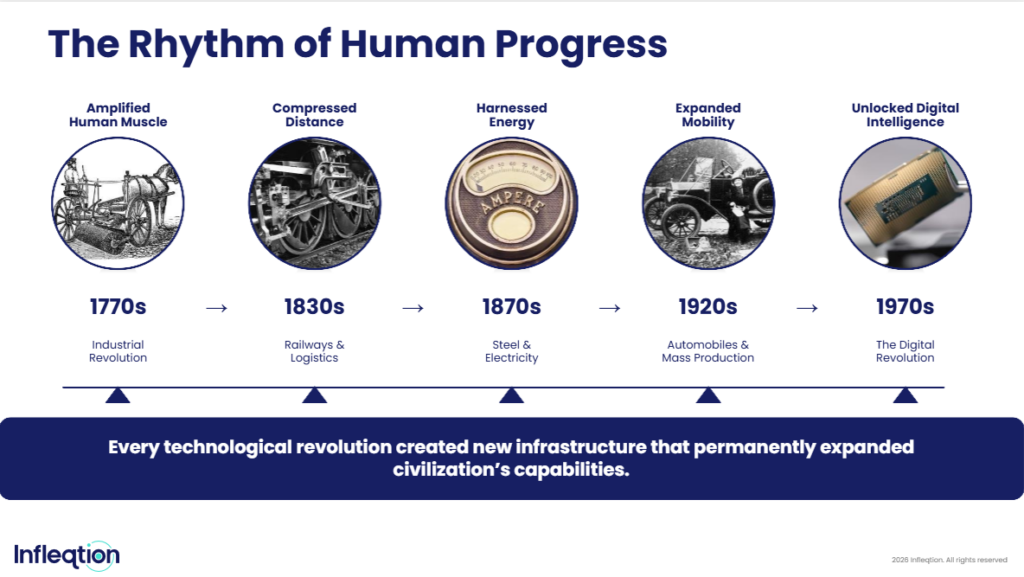
One of the books that has influenced my thinking more than any other is Technological Revolutions and Financial Capital by Carlota Perez.
Her central argument is remarkably powerful: Since the Industrial Revolution, humanity has advanced through a series of technological revolutions. Each one created entirely new infrastructure that permanently expanded civilization’s capabilities.
The Industrial Revolution amplified human muscle. Railways compressed distance. Steel and electricity allowed us to harness energy. Automobiles expanded mobility. The Digital Revolution unlocked digital intelligence.
Each transformation fundamentally changed how society worked. What began as seemingly radical ideas eventually became everyday infrastructure that defined entire generations. These revolutions don’t simply introduce new products. They change how civilization functions.
Technology Follows a Surprisingly Predictable Path
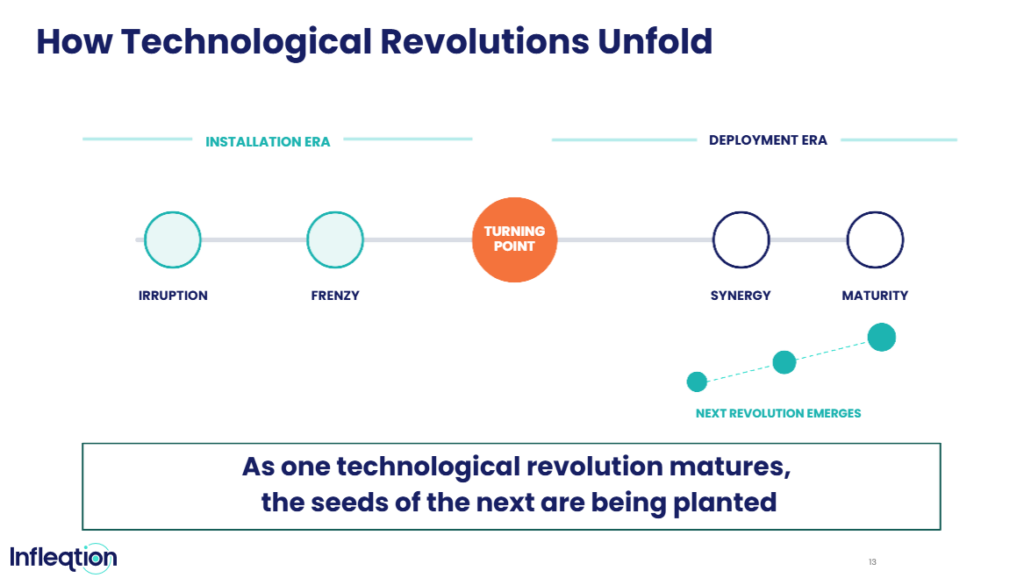
Perez also argues that technological revolutions unfold in a remarkably consistent pattern.
New technologies emerge and attract early believers. Investment accelerates. Excitement builds into a frenzy. Eventually, markets correct, sometimes painfully. But after that correction comes the period where society learns how to deploy the technology productively at scale.
The Digital Revolution followed this exact trajectory. The microprocessor arrived in the 1970s. Personal computer adoption expanded in the 1980s. The internet investment boom culminated in the dot-com bubble of the late 1990s. Following that correction, digital technologies entered decades of extraordinary productivity that transformed nearly every industry.
Today, we are living in the maturity of that revolution.
AI Represents the Pinnacle of the Digital Revolution
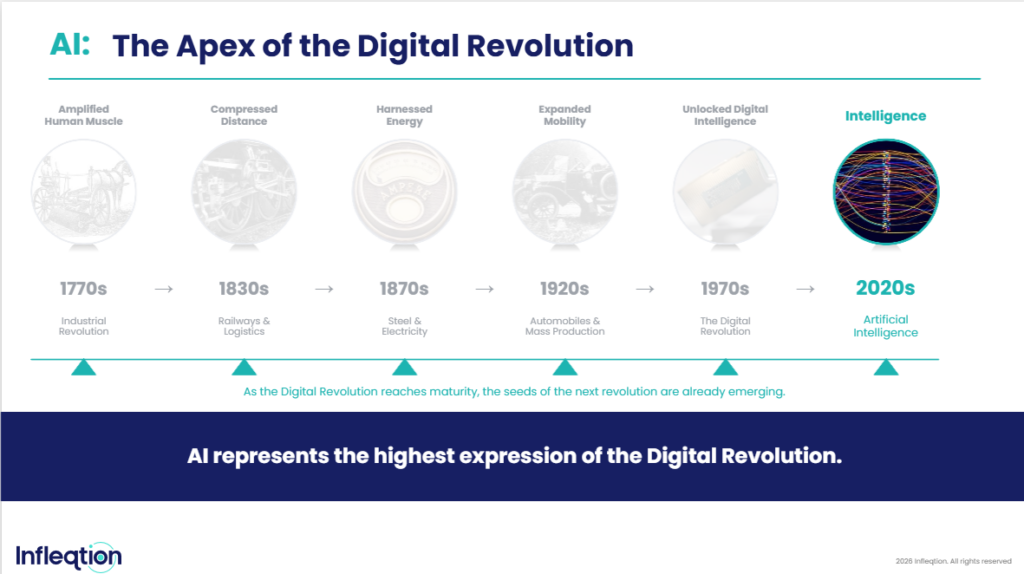
Many people naturally assume artificial intelligence represents the next technological revolution. I see it differently.
AI is one of the most important technologies humanity has ever created. But it is also the highest expression of the Digital Revolution rather than the beginning of a new one.
Even the world’s largest AI systems ultimately operate on digital infrastructure built over the last fifty years. They’re extraordinarily sophisticated, but underneath it all, they’re still processing zeros and ones. Which leads to a simple observation that sits at the center of my argument: The universe isn’t digital.
Nature doesn’t operate in binary. The physical world follows the laws of quantum mechanics.
That distinction matters because many of humanity’s hardest problems are fundamentally quantum mechanical. No matter how powerful classical computers become, there are classes of problems they simply cannot model efficiently because they’re translating a quantum world into digital approximations.
Quantum Begins the Precision Era
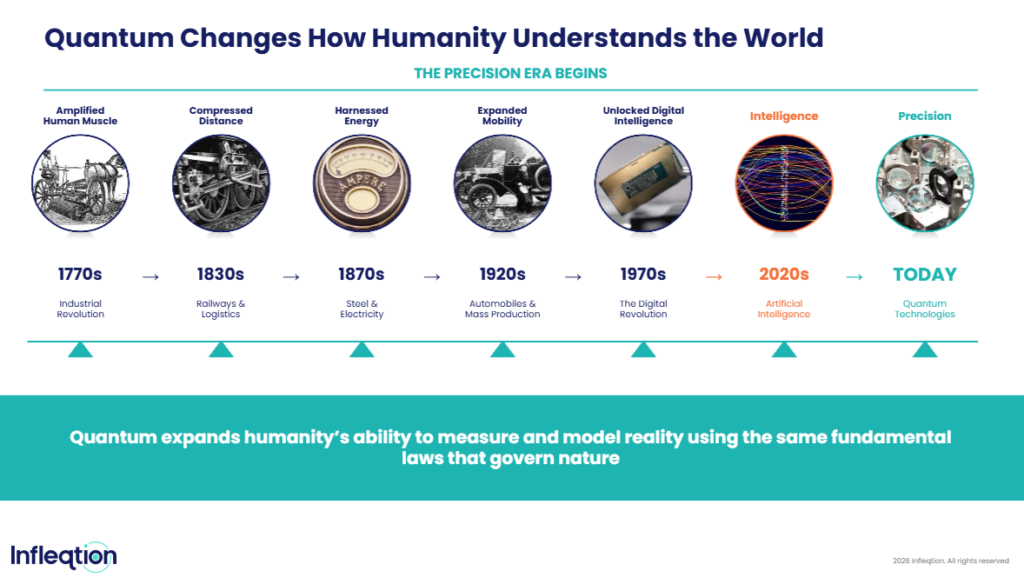
If the Digital Revolution gave us intelligence, what does quantum contribute? I believe the answer is precision.
Quantum technologies expand humanity’s ability to measure and model reality using the same physical laws that govern nature itself. That’s why I refer to this next chapter as the Precision Era.
Every previous technological revolution expanded what civilization could do. Quantum expands what civilization can know.
That distinction is profound.
Measure the World. Model the World.
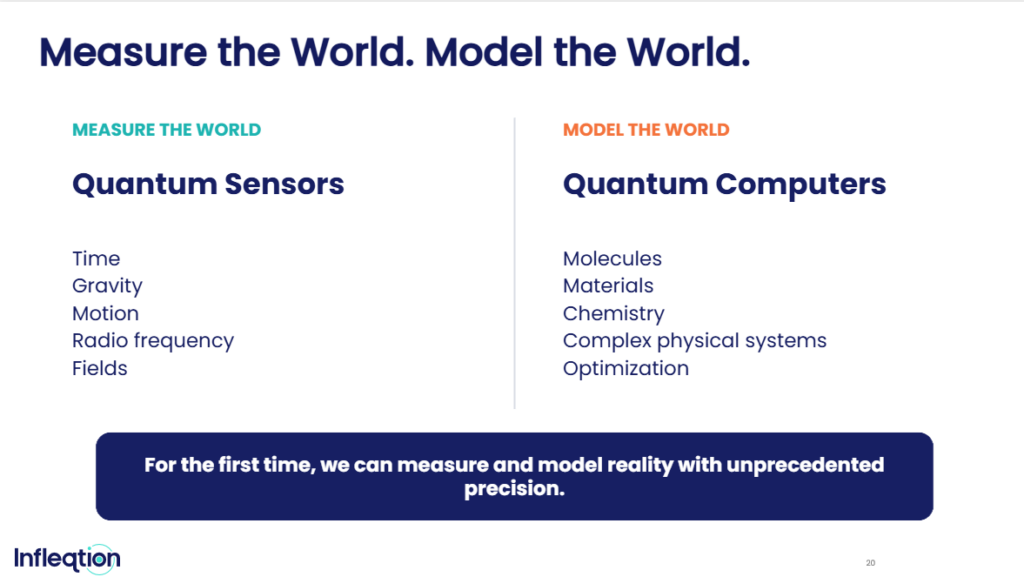
The Precision Era has two complementary components.
Quantum sensing allows us to measure aspects of the physical world that have previously been inaccessible, including time, gravity, motion, electromagnetic fields, and radio frequency with unprecedented precision.
Quantum computing allows us to model molecules, materials, chemistry, optimization problems, and other complex physical systems in fundamentally new ways.
These capabilities reinforce one another. We can’t model what we can’t observe. We can’t understand what we can’t model. And we can’t engineer solutions to problems we don’t yet understand. Together, quantum sensing and quantum computing provide a new foundation for scientific discovery and engineering.
What Becomes Possible?
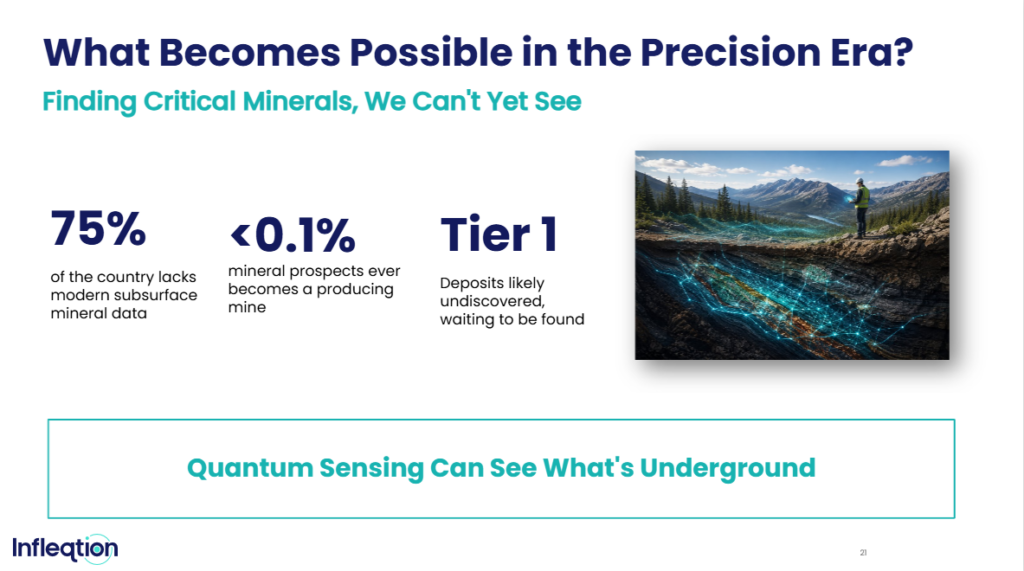
This isn’t about replacing existing technologies. It’s about making previously impossible work possible.
Consider quantum sensing: Today we’re developing gravity sensors capable of detecting subtle changes beneath Earth’s surface. Those measurements can help identify critical mineral deposits, monitor aquifers, or measure changes in polar ice mass from space with levels of precision that were previously unattainable.
Now consider quantum computing: One of the world’s most important chemical reactions, the Haber-Bosch process, enables fertilizer production that supports roughly half of the global food supply. Yet it consumes enormous amounts of energy because we still cannot accurately model the underlying chemistry. Nature already performs this reaction efficiently. We simply don’t yet understand the quantum mechanics well enough to reproduce it. That is exactly the kind of challenge quantum computing was built to tackle.
These examples illustrate a broader point. Better measurements produce better evidence. Better models reveal better possibilities. Together, they enable better engineering across energy, healthcare, and manufacturing.
Building the Infrastructure of the Precision Era
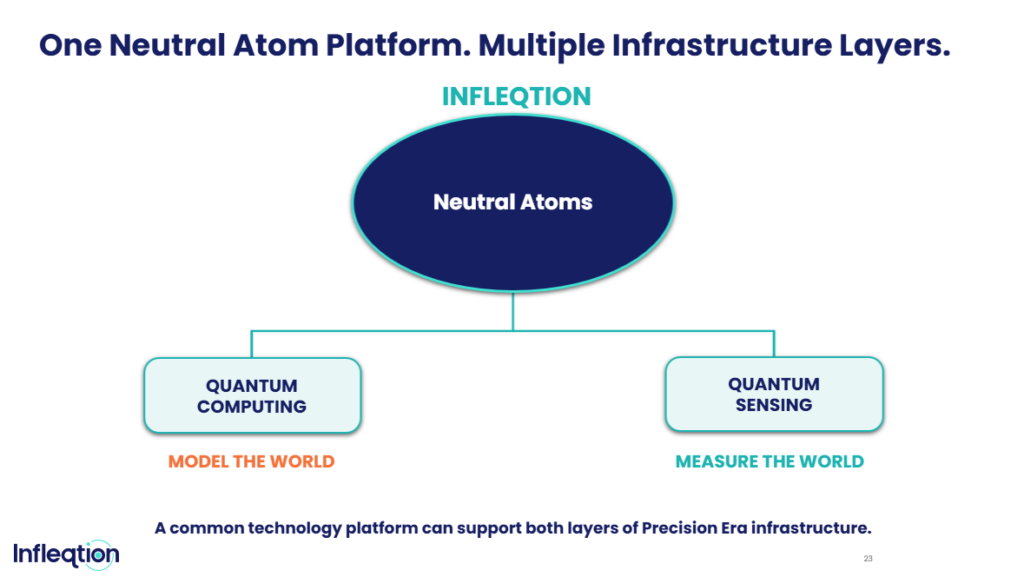
One of the reasons I’m so excited about neutral atoms is their versatility. The same underlying platform supports both quantum sensing and quantum computing. That’s important because the Precision Era won’t be built around isolated technologies. It will be built through interconnected infrastructure that enables entirely new capabilities.
At Infleqtion, we see ourselves as one participant in a much broader ecosystem that’s making this transition possible. Universities, national laboratories, startups, established companies, investors, and governments all have important roles to play as quantum moves from scientific research into deployable infrastructure.
The goal isn’t simply to build better quantum hardware. It’s to build the foundation for what comes next.
Standing at the Beginning
Imagine standing beside England’s first railways in the 1830s. Or watching New York’s streets light up after the first commercial power station came online. People living through those moments couldn’t fully appreciate how dramatically those technologies would reshape the century that followed. I believe we’re standing in one of those moments today.
I believe we’ll look back on this moment the same way. And when we do, I think Chicago will be remembered as one of the places where the Precision Era began to take shape. As someone who grew up here, it’s incredibly meaningful to play even a small part in that story.
Every generation inherits a technological revolution. Ours has the privilege of building one.
Watch the full keynote presentation video below.