
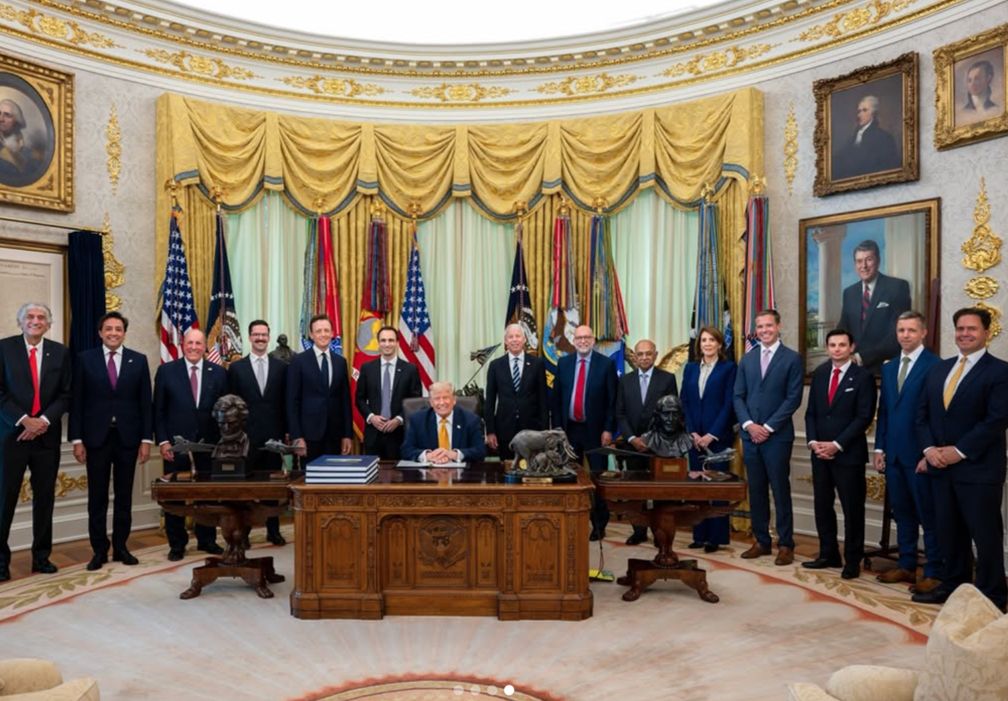
The story of quantum is shifting from one of scientific discovery to an industrial one. The first era was about proving the science: demonstrating that the strange and often counterintuitive properties of quantum mechanics could be harnessed reliably enough to become useful technologies. The second era, the one we are in now, is about deploying the systems built on that science. That shift, more than any single breakthrough, is the real story.
The administration deserves credit for recognizing it: leadership in this field will not be determined by discovery alone, it will be determined by who builds first, builds fastest and builds at scale. That is a familiar pattern in American history. It is also, historically, the part we have been best at.
The Next Infrastructure Layer
There is a useful way to think about why this moment matters, borrowed from the economist Carlota Perez, who has spent her career studying how technological revolutions actually unfold. Her research found that major economic eras arrive roughly once every fifty years, and each one follows the same pattern: a new technology does not simply replace what came before it. It becomes a new layer of infrastructure that the rest of the economy gets built on top of. Mechanization did it in the 1770s. Railways did it in the 1830s. Steel and electricity did it in the 1870s. The automobile did it in the 1920s. Information technology has been doing it since the 1970s, and arguably still is.
Much of the current conversation assumes artificial intelligence is the next such revolution. It may not need to be. AI may simply be the most powerful expression yet of the infrastructure layer we are already living inside (call it the intelligence layer). What has been missing is a layer beneath it: the ability to compute and measure at the actual limits of nature, rather than at the limits of our approximations of it. That is the layer quantum is positioned to provide. Call it the precision layer. It is not a competitor to AI. The two are likely to be built on top of each other, the way every infrastructure layer in Perez’s history was built on the one before it. The payoff ranges from new materials and medicines to more resilient infrastructure and entirely new capabilities in space.
The information that layer unlocks has always existed in the atoms around us, the molecules that determine whether a drug succeeds or fails, the materials that power our economy, the timing signals that synchronize modern infrastructure and the gravitational fields that shape our planet. For most of human history, it existed beyond our reach. What quantum offers is a new way to access it.
Beyond Models and Approximations
For decades, we have compensated for that limitation with increasingly sophisticated digital models, simulations and predictions. Those tools transformed the global economy and improved nearly every aspect of modern life. But a model is still a model.
Nature remains more complex than our approximation of it. Molecules do not care about our computational limits. Atoms do not behave according to the constraints of our spreadsheets. The physical world has always operated according to rules deeper than the tools we have had available to understand it. Quantum represents something fundamentally different: instead of building ever more sophisticated approximations of reality, we are beginning to build tools that operate using the physical world itself.
The Transition Has Already Begun
That distinction may sound abstract, but its consequences are not. Quantum clocks are beginning to provide resilient timing and navigation in environments where GPS can be jammed, denied or spoofed. Quantum sensors are opening new possibilities in energy, critical infrastructure, defense and space. Quantum computers are beginning to perform calculations that would have been dismissed as theoretical exercises only a few years ago.
None of this is arriving fully formed. It is arriving in pieces, in the field, ahead of schedule. The transition from scientific possibility to operational capability has already begun. Few people in the policy world still ask whether quantum will work. The conversations now are about how fast it can be fielded, and by whom.
The Real Competition Is Industrial Scale
History is a useful guide here. Most Americans remember the NASA space race culminating in the Apollo 11 Moon landing in 1969. Far fewer remember the vast network of suppliers, manufacturers, engineers and technicians who made it possible. The same is true of the semiconductor revolution: the invention mattered, but the industrial ecosystem that followed mattered more. In both cases, the discovery created the opportunity. The industrial buildout captured the value.
The countries that lead the quantum era will not simply be the countries that invent these technologies. They will be the countries that build the workforce, manufacturing capacity, supply chains, partnerships and industries required to deploy them at scale. China has already made the choice. Its new five-year plan names quantum technology as the first of seven priority “future industries,” backed by a national venture fund that has earmarked roughly $17.5 billion across three regional vehicles for quantum computing, sensing and communications, among other strategic technologies. That is not a research budget. It is an industrial one.
The stakes are economic competitiveness, national security and jobs.
The current conversations in Washington about workforce development, domestic supply chains, commercialization and public-private partnerships are therefore not side issues. They are the mechanism through which scientific leadership becomes economic leadership and economic leadership becomes national strength.
Why Quantum Matters Beyond Computing
The implications extend well beyond computing. The next phase of American space activity will depend as much on advances in timing, navigation, sensing and communications as it does on launch vehicles. Quantum technologies are increasingly becoming part of that future, and the same dynamic is beginning to emerge across energy, telecommunications, advanced manufacturing and defense.
A new coalition, America’s Quantum Space Initiative, is bringing together Infleqtion, Voyager Technologies, Monarch Quantum, the University of Colorado Boulder and others to begin moving quantum sensing, timing and communications technologies from demonstration into deployed space infrastructure.
Turning Momentum Into Leadership
Washington appears to be moving in the same direction. In May, the Commerce Department distributed more than $2 billion in CHIPS Act funding to nine American quantum companies, attaching real capital to domestic production rather than research alone. The administration is now considering coordinated roadmaps for quantum networking and sensing, deeper public-private partnerships, and stronger protections for American quantum research. Congress is also progressing on the passage of the National Quantum Initiative Reauthorization Act of 2026. The passage of that legislation, coupled with the recent Quantum Executive Orders #14411 and #14409, will send a strong signal to both our allies and partners, as well as non-like-minded countries, that quantum is a bipartisan U.S. priority.
In the coming months, they will be a real and welcome show of U.S. leadership, exactly the kind of decisive action this moment requires, not another study or symbolic gesture. Washington should build on this moment, not let it stand alone. A roadmap only matters if it survives the news cycle that produced it. That means sustained, multi-year funding rather than symbolic gestures, an empowered federal advisory structure that includes the people actually building these systems, and a clear signal to private capital that the government intends to be a long-term partner in this industry, not an occasional one. What this moment requires now is speed, action and leadership that doesn’t let up once the announcement fades.
The Era of Building Has Begun
In the end, this is not a story about quantum. It is about whether the United States recognizes what phase of that story it is in. The era of proving the science is ending. The era of building around it has begun.
Quantum science is no longer the question. Building around it is.